
HIGH-SPEED PRESS SELECTION
Choosing a High-Speed Press?
Look Beyond Tonnage and SPM.
Crank or Toggle?
Choose the Right Press for Your Process.
Why can two precision high-speed presses with similar tonnage and stroke rates perform differently in actual production?
The key is not which press runs fastest, but which best suits your die and can sustain stable, long-term production.
01
CRANK
VS TOGGLE
MECHANISM / PROCESS
Crank vs. Toggle:What Is the Difference?
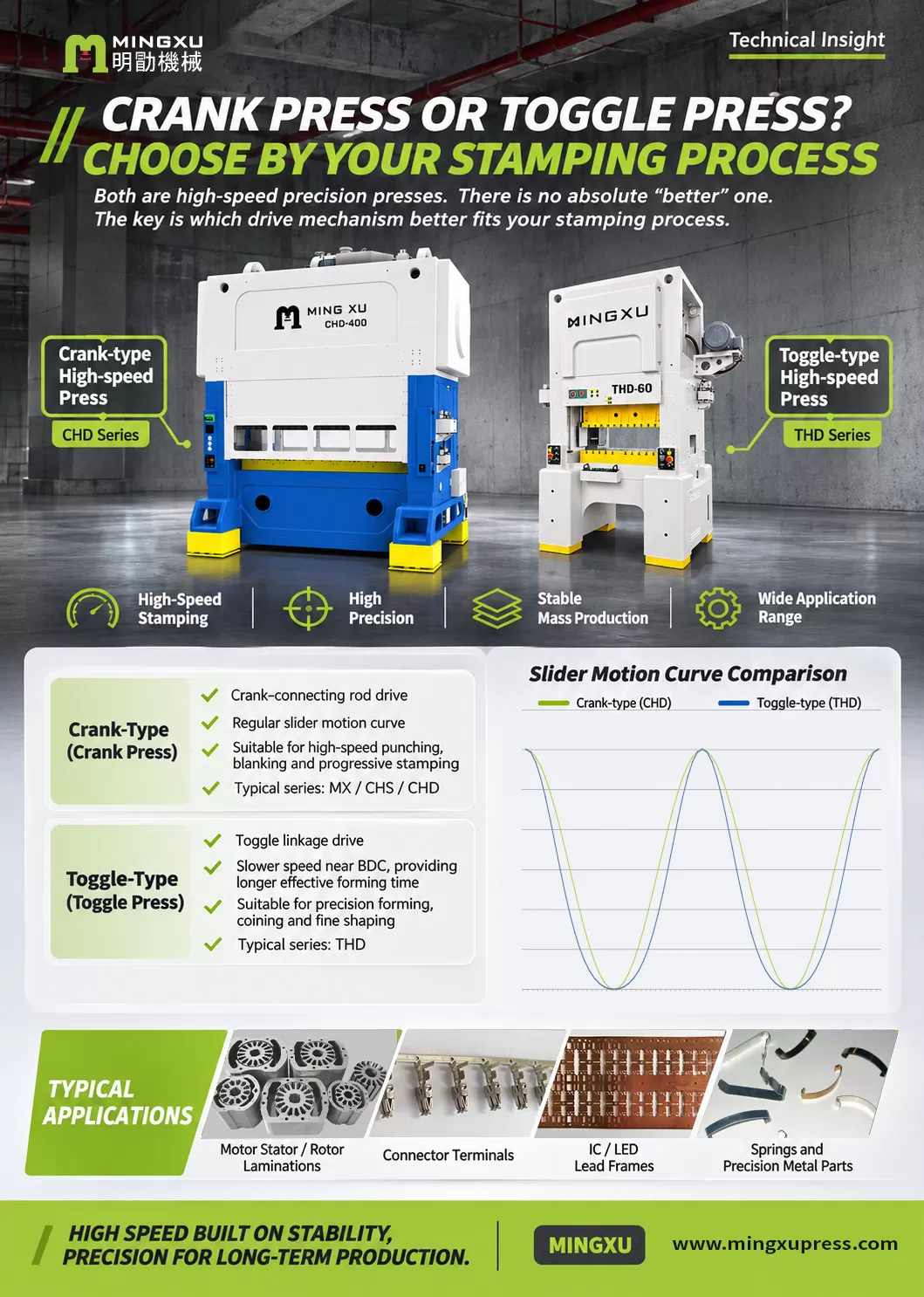
Crank-Type High-Speed Press
MX / CHS / CHD Series
PRODUCT LITERATURE / PDF
MX Series brochure (20 Nov 2026)
CHS 80–150 brochure
CHS 250–350 brochure
CHD 80–400 brochure (Chinese, 20 Nov 2026)
A crank-and-connecting-rod mechanism is well suited to high-speed piercing, blanking and cutting with progressive dies, where production rate, stamping force and operating stability are key considerations.
Toggle-Type High-Speed Press
THD Series
A toggle linkage reduces slide speed near bottom dead center (BDC), extending the effective forming time. It is suited to precision coining, sizing and selected ultra-thin material stamping applications.
TECHNICAL NOTE
Slower forming motion in a toggle press does not mean that the slide stops to hold pressure, nor does it necessarily mean that the press is more accurate than a crank-type press.
Slide Motion Curves: Crank vs. Toggle
SLIDE POSITION VS CRANK ANGLE
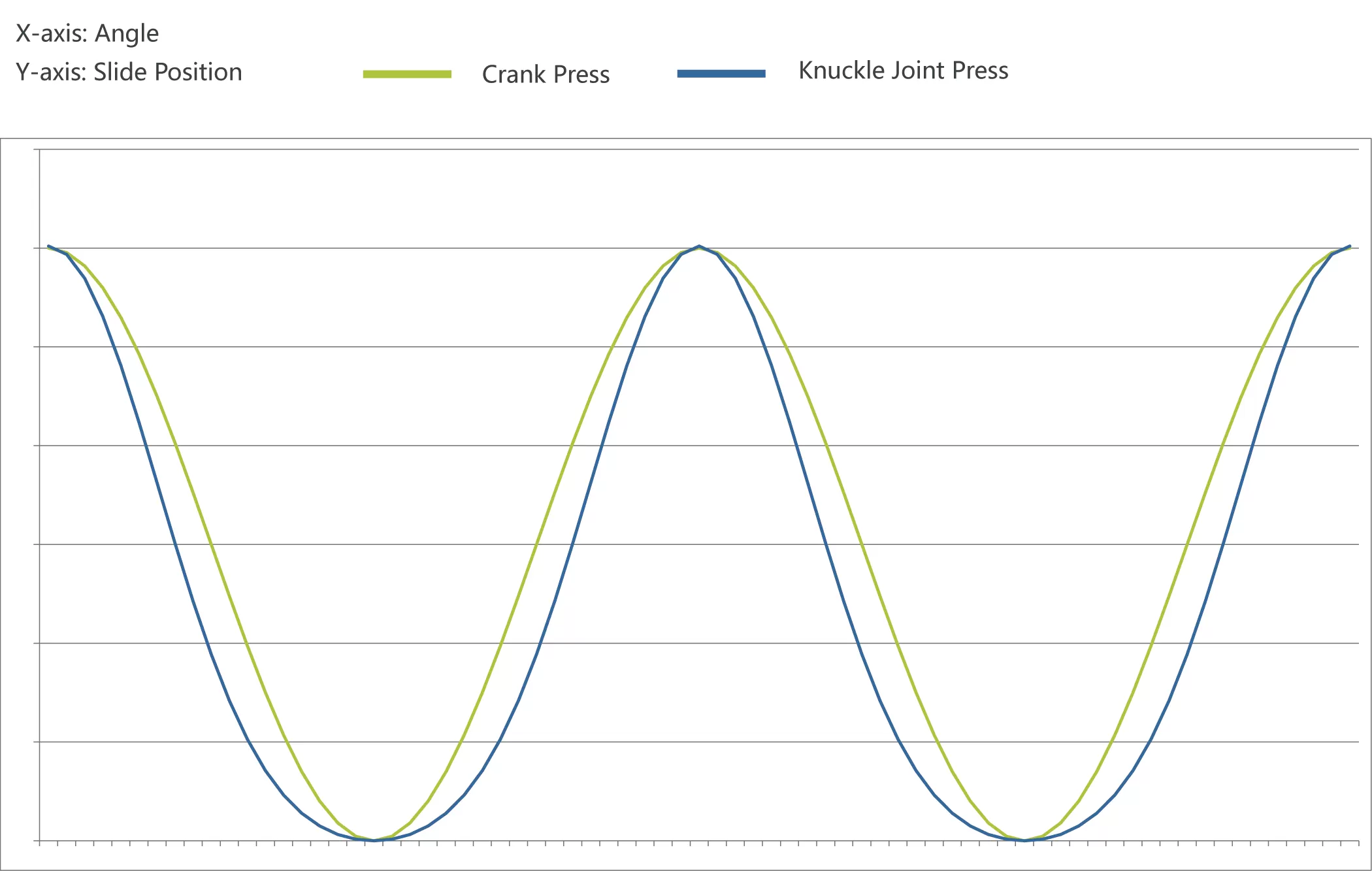
The chart shows slide position versus crank angle, not slide velocity directly. Actual slide velocity must be assessed from the curve slope and rotational speed.
02
MATERIAL
THICKNESS
SELECTION REFERENCE
Stamping 0.2 mm Electrical Steel?
How Should You Select a Press?
Material thickness is an important selection factor when stamping motor stator and rotor laminations. Based on MINGXU’s practical application experience:
ELECTRICAL STEEL
0.2 mm
Based on MINGXU’s application experience
> 0.2 mm
Material thickness above 0.2 mm
CHD
Consider evaluating a crank-type precision high-speed press first.
< 0.2 mm
Material thickness below 0.2 mm
THD
Consider evaluating a toggle-type precision high-speed press first.
0.2 mm is not a universal industry threshold.
The final selection should also account for die design, cutting force, BDC stability and die trial results.
03
PRODUCTION
STABILITY
LONG-TERM PERFORMANCE
An Impressive Maximum SPM.
But What About Continuous Production?
When purchasing a high-speed press, look beyond tonnage and maximum stroke rate. Ask these questions:
BUYER'S CHECKLIST
SPM 01 / SPEED
What stroke rate (SPM) can the press sustain with the actual production die installed?
8h / 12h 02 / STABILITY
How well does the press maintain BDC accuracy and thermal stability after 8 or 12 hours of continuous production?
QUALITY 03
Do burr levels, dimensional consistency and forming quality meet the requirements for the stamped parts?
Accuracy at the time of shipment matters. Stability throughout long-term production is equally important.
Planning a Press Purchase? Let’s Talk.
If you are planning a new production line, purchasing equipment or replacing an existing press, feel free to share the following in the comments:
01 / STAMPED PART
Motor core laminations, connector terminals, IC/LED lead frames or other precision components?
02 / MATERIAL THICKNESS
0.35 mm, 0.2 mm or thinner?
03 / TARGET STROKE RATE
What is your target SPM?
The MINGXU engineering team can help assess a suitable press solution based on your material, die requirements and production capacity targets.
MINGXU / SINCE 1993
MINGXU Precision Machinery
Since 1993, specializing in the development and manufacture of precision high-speed presses.
High Speed Built on Stability.
Precision Proven in Long-Term Production.